Insta360 has just launched the Insta360 Mic wireless microphone. Positioned between the ultra-compact entry-level Mic Air and the flagship Mic Pro, this mid-range product retains the Mic Pro’s signature customisable colour E-Ink display, adds a handy microSD card slot for expanded internal recording, and comes at a more affordable price.
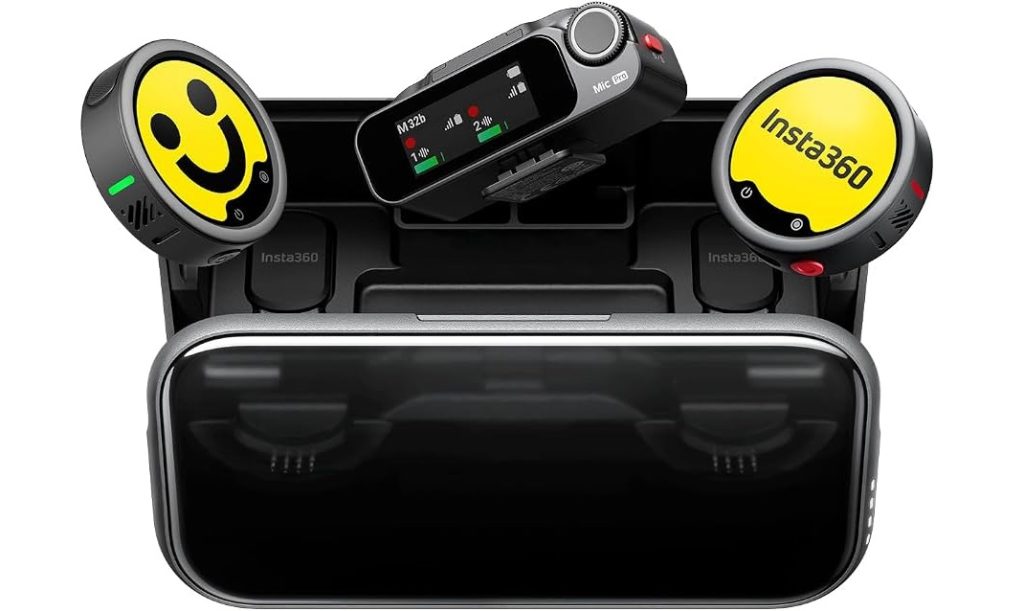
Insta360 Mic Specifications
The transmitter features a compact circular design measuring 38 × 12.2 mm and weighing approximately 19.4 grams. Each transmitter is fitted with an omnidirectional pickup capsule with a frequency response of 20 Hz to 20 kHz. Sensitivity is rated at -38 ±1 dBV (1 kHz / 94 dB SPL), with a signal-to-noise ratio of 72 dB (A-weighted), an equivalent noise level of 22 dB (A-weighted), and a maximum sound pressure level of 130 dB (10% THD). The sampling rate is 48 kHz. Wireless transmission uses 24-bit depth, whilst internal recording can be set to either 24-bit or 32-bit float.
On the front sits a 1.22-inch six-colour E-Ink display. You can customise the display via the Insta360 app, adding logos, emoji, pet photos, brand graphics, or simple colours. The image remains visible even when the device is switched off, and it stays clearly readable in direct sunlight. This makes it easy to identify speakers during multi-person shoots, or to make the microphone look like part of your personal brand.
Internal recording requires a microSD card. Once a card is inserted, the transmitter records backup files locally at 32-bit float or 24-bit, 48 kHz. The 32-bit float format uses roughly 700 MB per hour, whilst the 24-bit format uses about 500 MB per hour. The 32-bit float format applies to local recording only. Wireless transmission to the receiver works in the conventional way. Without a microSD card, the system still functions normally via the receiver or a direct Bluetooth connection, it simply won’t generate backup files.
Other key specifications:
- Battery life: A single transmitter is rated for up to 13 hours, the receiver for up to 11 hours, and total runtime reaches up to 34 hours when used with the charging case.
- Transmission range: Up to 400 metres in open, interference-free environments.
- Connectivity: One receiver can connect to up to four transmitters. Two transmitters can connect to up to four receivers. Mic and Mic Pro transmitters are cross-compatible on the same receiver.
- AI noise reduction is powered by a dedicated NPU chip, with automatic and dynamic gain modes plus three voice tone presets.
- Direct Bluetooth connection to compatible cameras, including the X6, X5, Luna Ultra, Luna Pro, GO Ultra, and Ace Pro 2. The X6 and Luna models support dual-transmitter connection.
How It Differs from the Mic Pro
The Mic keeps the E-Ink feature and most of the practical workflow functions, whilst simplifying certain hardware components to bring the price down.
The biggest practical trade-off is that the Mic uses a single omnidirectional pickup capsule, whereas the Pro is equipped with a three-microphone array that lets you switch pickup patterns at any time. For most vlogging, interviews, podcasting, and everyday content, an omnidirectional pattern is more than sufficient, especially with the AI noise reduction and gain tools on board.
If you need more storage or want to swap media quickly, the microSD card approach is actually more flexible than the Pro’s fixed 32 GB capacity. Battery life has improved, though not dramatically. And because the receiver is shared, you can mix Mic and Mic Pro transmitters within the same system.
Pricing and Availability
The Insta360 Mic launched globally on 22 October. Pricing for Europe:
- Single transmitter: €85 / £75
- One transmitter + receiver bundle: €149 / £129
- Two transmitters + receiver + charging case bundle: €269 / £229
Every configuration is priced below the equivalent Mic Pro bundle. For creators who already own a Mic Pro receiver or charging case, buying a single transmitter is a particularly cost-effective way to expand their setup.