A decade ago, Sony introduced the Action Cam Mini HDR-AZ1 as a compact response to GoPro’s dominance. The camera was roughly the size of a thick USB stick and weighed about 63 grams with the battery, making it one of the lightest wearable cameras available at the time. It recorded Full HD video, used electronic image stabilization, featured a Zeiss Tessar lens, and offered Wi-Fi plus an optional live-view remote.
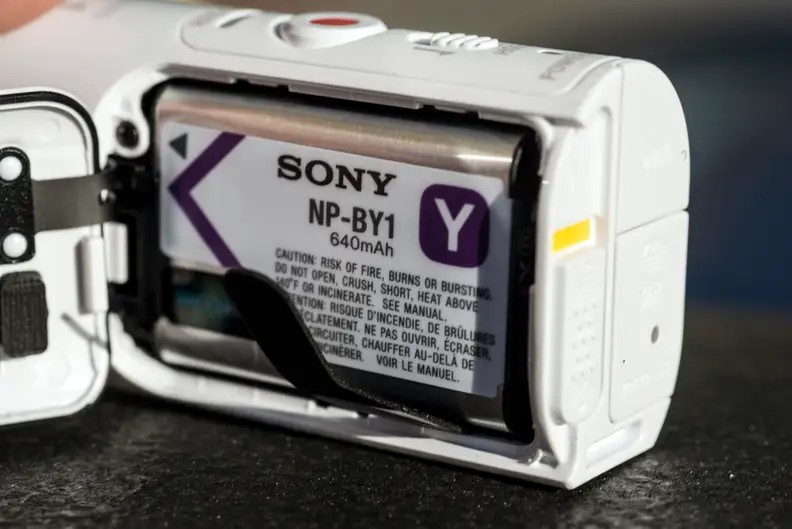
Image Quality and Trade-offs
In good light, the AZ1’s 1080/60p or 1080/30p footage remains sharp, with natural color. The electronic stabilization is still useful, though it narrows the field of view. For mounting discreetly on a helmet, bicycle, or backpack strap, the camera’s form factor remains hard to match. Reviews at the time, including those from CNET and Digital Trends, praised the balance between size and performance while noting clear weaknesses: no 4K, limited manual controls, and especially battery life.
The Battery Was Always the Weak Point
The AZ1 uses the slim NP-BY1 battery, rated at 640 mAh. Sony’s official figure was about 80 minutes of continuous 1080/30p recording, but real-world mixed use was closer to 45 minutes. Independent tests typically landed between 60 and 80 minutes depending on settings and Wi-Fi use.
Even when new, endurance was not a strength. After more than a decade of charge cycles, most original batteries have lost significant capacity. If a battery dies after 20 minutes, the camera becomes nearly unusable.
Cheap Third-Party Batteries Solve the Most Common Failure
Third-party NP-BY1 batteries remain easy to find and inexpensive. They fit the camera, are recognized by it, and are commonly rated for similar runtime to the original. Replacement takes about five minutes: slide the latch, remove the old battery, and insert the new one.
When Replacing the Battery Makes Sense
For owners who already have the AZ1 and its accessories, replacing the battery is worthwhile if the camera is used as an ultra-compact 1080p point-of-view camera for occasional cycling, skiing, or travel vlogging.
A new battery restores usable runtime for a fraction of the cost of any modern action camera. The body is still durable, the lens is still sharp enough, and the optional live-view remote remains one of the most convenient controls of that generation. For simple set-and-forget lightweight shooting, the AZ1’s size still offers appeal that bulkier modern cameras do not.
When It Does Not Make Sense
For anyone expecting modern performance, the answer is no. The AZ1 cannot match current cameras such as the GoPro Hero or DJI Osmo Action in resolution, dynamic range, stabilization, battery life, low-light performance, or software features. It lacks 4K video, advanced horizon leveling, voice control, and meaningful firmware support.
Accessories beyond batteries are also harder to find. Replacing the battery only makes sense when the camera already meets a specific need. Otherwise, the same money—or slightly more—can buy a used modern camera that is far better for everyday use.