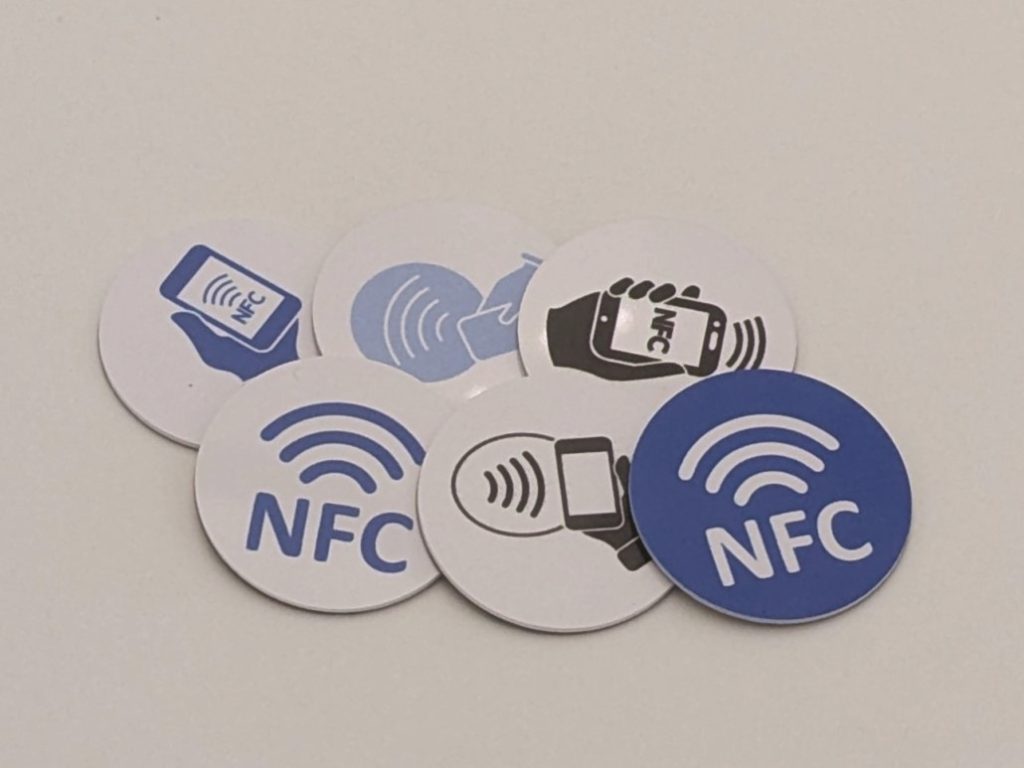
If you have stayed in a hotel at any point in the past five years, you have probably noticed that key cards have changed. Some hotels now use credit-card-sized wooden cards that communicate with the door in some way, while others let you unlock your room with your phone. That clever little thing is an NFC tag.
NFC stands for near-field communication. It is a short-range wireless technology that allows two devices to exchange small amounts of data when they are within a few centimetres of each other. An NFC tag is the simplest application of this technology: a tiny, battery-free chip connected to a coil antenna. It lies completely dormant until a powered device, usually your smartphone, comes close enough to wake it up.
What exactly is inside an NFC tag?
Most flat tags are simply a stack of a few thin layers:
- A printable surface (paper or plastic film)
- A flat coil antenna, usually made of copper or aluminium, tuned to 13.56 MHz
- A tiny integrated circuit (the actual chip, often smaller than a grain of rice)
- A layer of adhesive backing
And that is all. The chips most commonly found in stickers and cards come from NXP Semiconductors’ NTAG range (NTAG213, NTAG215, NTAG216), which differ mainly in how much data they can hold, roughly 144, 504 or 888 bytes of user memory respectively.
Because the hardware is so simple, NFC tags can be embedded in almost anything: credit cards, key fobs, product packaging, business cards, posters, and even clothing labels.
How it works without a battery
The trick lies in electromagnetic induction, the same basic principle that wireless charging pads use to charge your phone, only on a much smaller scale.
When you tap a tag, your phone’s NFC antenna generates a faint alternating magnetic field at 13.56 MHz. When the tag enters this field, the magnetic energy induces a weak electric current in the tag’s coil. That current powers the chip and wakes it up.
The chip then subtly alters the electromagnetic field to send its stored data back to the phone. The phone detects these tiny changes and reads them as data.
Since all of the tag’s energy comes from the reader’s magnetic field, a tag will still work when tapped even after lying unused for years.
Unlike long-range RFID, NFC tags are deliberately designed to have a very short working range, ideally under 10 centimetres and often just 1 to 4 centimetres in practice. This short distance exists mainly for security reasons.
NFC tags are not the same as trackers
An NFC tag is not a slimmer version of a tracker. The two are entirely different. A tracker runs on its built-in battery and actively broadcasts Bluetooth signals for other devices to detect and pick up. An NFC tag, by contrast, is passive and can only transmit data when a reader supplies it with power.